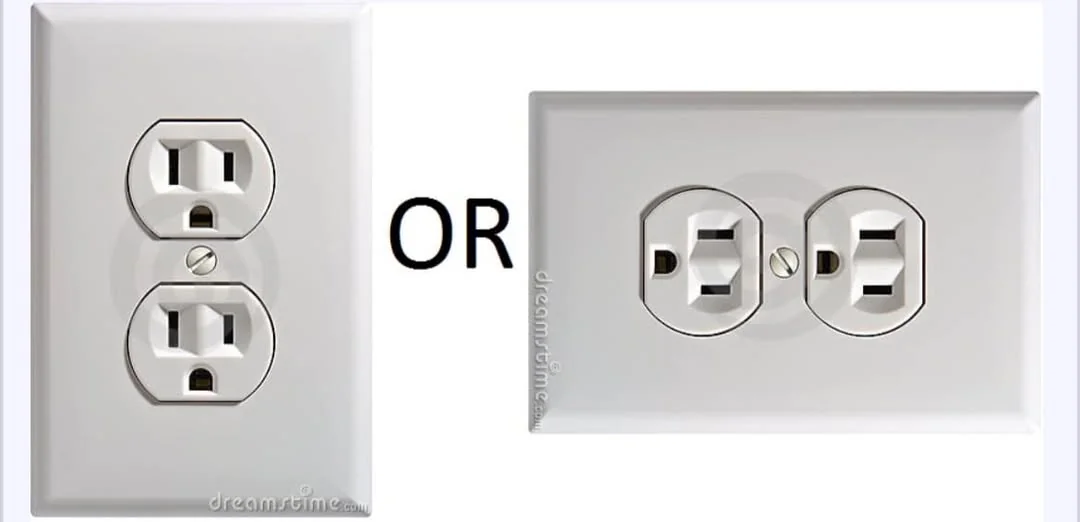
Many people have noticed electrical outlets installed with the round grounding hole at the top instead of the bottom and immediately assumed they were installed incorrectly. At first glance, it may look like a simple mistake, but in reality, there is often a practical reason behind this unusual orientation.
One of the most common explanations has to do with switched outlets, a feature that was especially popular in older homes. Before ceiling light fixtures became standard in every room, homeowners often relied on floor or table lamps for lighting. To make those lamps easier to use, electricians would wire part of a wall outlet to a nearby light switch. That way, flipping the switch would turn the lamp on or off without anyone needing to reach behind furniture to operate the lamp itself.
In these situations, the outlet is typically split into two separate sections. One receptacle is connected to the wall switch and only receives power when the switch is turned on, while the other receptacle remains energized all the time. This allows homeowners to plug a lamp into the switched half while still using the other half for items that require constant power, such as phone chargers, clocks, Wi-Fi routers, or other electronics.
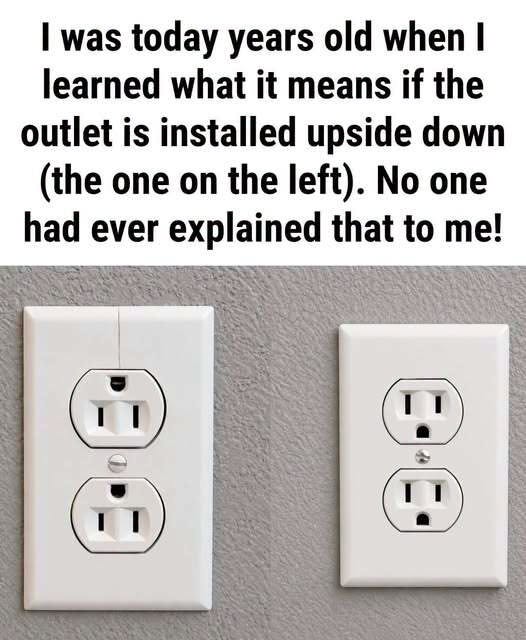
Some electricians choose to install these switched outlets upside down—with the grounding hole facing upward—as a simple visual reminder that the outlet functions differently from a standard one. It serves as a convenient cue for homeowners, electricians, and maintenance workers. However, it’s important to understand that this practice is based on personal or regional convention rather than any official requirement.
In fact, the National Electrical Code does not require outlets to face in any particular direction. As a result, the orientation of outlets can vary greatly depending on the electrician who installed them, local construction traditions, commercial versus residential standards, or even the preferences of the builder or homeowner.
There are also other reasons why an outlet may be installed upside down. In some commercial buildings, schools, hospitals, and offices, electricians prefer this orientation because it can slightly reduce the risk of a metal object falling onto a partially exposed plug and causing a short circuit. Others simply prefer the appearance or follow local building customs that have been passed down over the years.
Because there is no universal standard, seeing an upside-down outlet doesn’t automatically mean it is connected to a switch. It could be switched, it could be part of a safety practice, or it might simply reflect the habits of the person who installed it.
The easiest way to find out how an outlet actually works is to test it. Plug in a lamp or another simple device and flip the nearby wall switches. If the lamp turns on and off with one of the switches, you’ve found a switched outlet. If nothing changes, the outlet is most likely always powered.
So, the next time you spot an upside-down electrical outlet, don’t assume it’s a mistake. What seems unusual is often a thoughtful design choice, reflecting practical wiring decisions, safety considerations, or long-standing installation traditions rather than an installation error.